
Licence to Look. Some reflections on designing one particular space
Before memory can be prescribed and swallowed whole, before it is packaged into participation, sold as merchandise, or flattened into a grainy image for the feed, there is the uncomfortable act of looking: of standing before something and allowing it to look back.
Now, reader, let me start with some accompanying notes. For the sake of keeping up with the Zeitgeist, it currently being ChatGPT-generated text style, first I’ll tell you what this text is not before telling you what it is (if you don’t understand me, you are not online enough, which is frankly amazing). It is not an academic essay or a deep delve into theories of observing in architectural production or planning, although I might mention Foucault’s and Rossi’s concepts. It is also not a critical Auseinandersetzung with any built projects. It is, however, a short reflection on the personal process of designing a space of observation. Isn’t any space a space of observation? Yes, but this one embodies it as a primary function, being a pavilion dedicated to learning about things hidden from view, namely, about Serbian society learning about the genocide committed in Srebrenica. (Here, I caught myself considering adding an official the Hague reference for the court proceedings stating that it was a genocide, as milder opinions on this topic have been normalised in Austria. See: one of the beloved local Nobel winners in literature.)
Who gets to look, who is exposed, who controls the frame, and whether looking carries responsibility were some of the topics thematised by the design proposal. The three “whos” hint at the wish to treat the spectator as an integral part of the memorial, which—importantly—is itself also being looked at.
So, to give proper context: In 2021, a group of brave non-governmental organisations in Serbia (Inicijativa mladih za ljudska prava, Forum ZFD Srbija, and Nezavisno društvo novinara Vojvodine) organised an open competition for the memorialisation of the Srebrenica genocide in Bosnia, the deadliest crime committed on European soil since WWII, while in Serbia it continues to be contested in many different ways—from questioning the number and identities of the victims to challenging the legitimacy of international verdicts. For many people in Serbia, a critical examination of the responsibility of their own society and state in carrying out and denying the genocide has remained unrealised (read: not only is there widespread glorification of war criminals in public, but the President himself was present during the war, more precisely on Serbian military posts from which citizens of Sarajevo were being shot at, carrying… either a rifle or an umbrella). This is all particularly significant for younger generations whose memories of the war are, at best, second-hand.
Drawing every line on a design proposal tackling this should carry both an immense responsibility and introspection, even more so as they both lack in the post-war Bosnian political field, where this genocide was also abused as a tool in political campaigns of ethnonationalist parties, troubled financial handling surrounding international donations, and, to name the most contemporary one, the unwillingness of the official Memorial institution of Srebrenica to voice solidarity with currently ongoing genocides, choosing wisely which neveragains are politically correct.
So, how have each of the fragments of the complex denial skeleton in Serbia’s closet affected the design itself?
Now, collective identity, and belonging to a group, is often both a shelter and an obstacle to critically questioning reality. In order to tackle this, the decision was made to design this monument as a very intimate space of detachment from the group, and of being an individual making individual decisions. Akin to a public restroom, this monument is a micro-pavilion, measuring 3 × 3.5 metres in total footprint, designed to serve people within public space. I understand the initial inappropriateness of comparing a genocide memorial to a toilet for anyone who has been dealing with this topic in the deranged political reality of the Balkans—sensibility heightened to the max and triggers all around—and also knowing the spatial reality of public toilets in our region. But nevertheless—the notion of privacy in public and freedom from the collective gaze, a space that enables a journey towards the primal centre of oneself, in this case in search of empathy and solidarity—it might be overreaching, but I stand by it. Two years later, after watching Wenders’ Perfect Days, I imagined myself cleaning this monument every morning and preparing it for visitors.
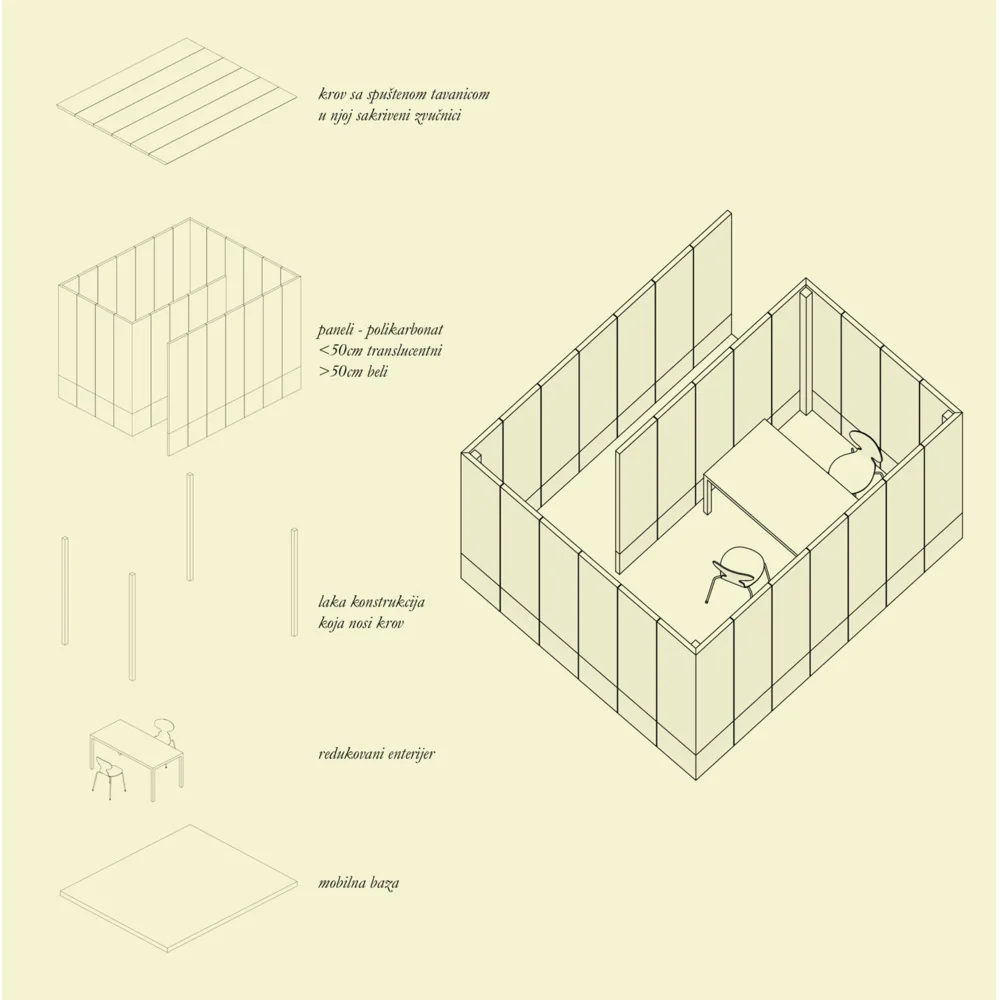
Through the orthogonal spiral in its floor plan, the pavilion is simultaneously inviting, due to its pronounced entrance, and intimate, due to its clearly separated interior for one person. The façade panels provide privacy for the visitor, while a translucent section at ground level clearly indicates whether the space is occupied or available. But make no mistake: the moment they exit the polycarbonate threshold, the visitor is the one observed. (Actually, even before: the community observes through the translucent slit if there are even people willing to engage with this history, if the space is being used. The hope was that, seeing the others, they might try it out as well.) So the act of looking inside is simultaneously the act of allowing yourself to be looked at by others in the public space as someone interested in questioning the predominant, government-backed narrative.
Allow me to compare this with the most obvious architectural reference for the topic in question. The Panopticon as a machine that separates the act of seeing from being seen: one sees without being seen, while the other is visible without being able to see the observer. But in this memorial project, it is exactly the opposite. It is a machine that inextricably connects the act of seeing with being seen. It is a difficult and conscious decision a visitor needs to make, a first step towards knowledge. A counter-panopticon, if you wish.
And another aspect of that same narrative shaped the interior decisions for the memorial. The dialogue surrounding the war reduces victims too often to numbers, to groups, to initials—their individual identities becoming lost in the tragic translation of events into documents, and from documents into public discourse—even when there is a discourse allowed to happen.
The aim of this memorial was to create, in this micro-space, an opportunity to encounter the victims through their individual identities, rather than reducing them to statistics. Kurzgesagt: the visitor listens to the story of individual victims while sitting at a table. The space is white, reduced, intimate. It contains two chairs: one for the visitor, and the other for the person made absent by the war, the person whose story the visitor is listening to. Because, unlike in many other war crimes, this one specifically targeted men and boys, which left many of the female family members alive to share the fragments of their relatives’ lives, interests, loves. So, in a Benjaminesque way, in which history appears through fragments and moments in which something previously unseen can suddenly become legible, the audio trace becomes powerful precisely because it is fragmentary.
The carefully arranged wall-to-wall-seating setting suggests a duality and an encounter, while at the same time preventing the second chair from being used by clearly indicating that it is not intended for the visitor—but for the person who is absent, whose story is told by a voice coming from a speaker in the ceiling. Absent persons are presented one at a time, and for those whose identities are unknown or poorly documented, silence describes their absence: an interruption in the audio recording marks their absence from collective memory and creates a sonic gap.
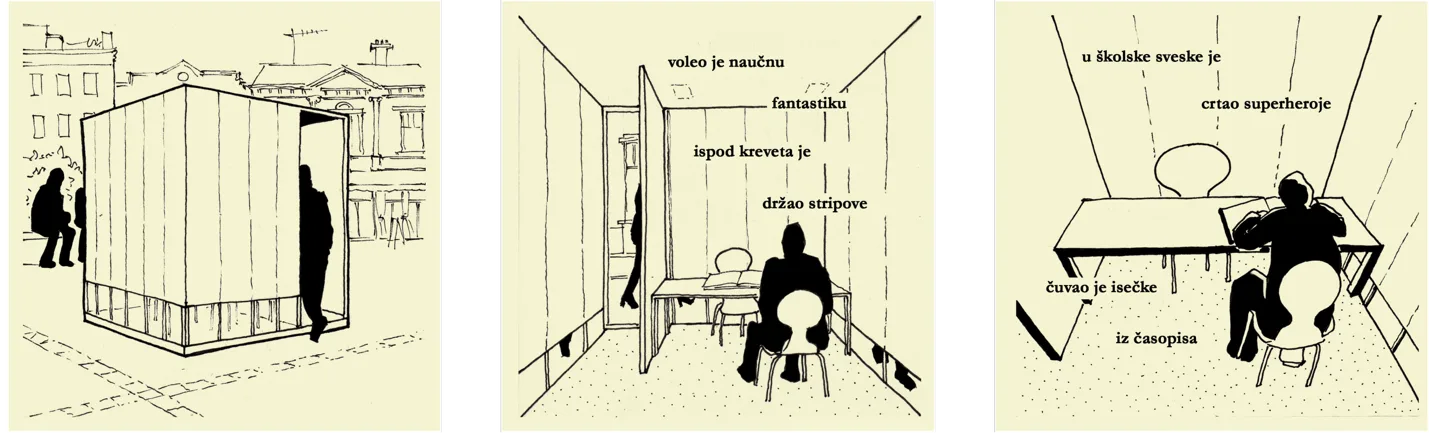
I asked a friend in Serbia if he would like to collaborate on this project, hoping not just for his on-point illustrations, but for his local insights and critical understanding of the specific flavour of xenophobia and denial. Enter Matija Zlatanović, who made sure that the intentions would be understandable for all who will never read any text (but not you, reader, you are still here, right?).
A lot of time has passed since the genocide, almost my whole life. Bridging this temporal gap was an important impulse, employing the visitor. How to meaningfully insert today into the early 1990s?
A book is placed on the table, allowing the visitor to transform their thoughts and reflections into words and to leave an anonymous message—to offer support, to ease their conscience (parts of the bodies are still being searched for, many mass graves found after anonymous tips about where victims were buried), or to ask a question. The contents of the book, however controversial they may be—and they surely would be—become an artefact and a document of the current state of collective memory.
The pavilion therefore contains three temporalities at once: the absent past represented by the empty chair; the present embodied by the visitor; and the future contained in the written trace that the visitor leaves behind. The memorial becomes a small machine for connecting these three conditions.
And the machine is cheap and mobile, allowing it to travel through Serbia and elsewhere (elsewhere being mostly Republika Srpska—part of Bosnia and Herzegovina with a majority ethnic Serb population), to places where people live who could use a space for reflection, learning, and solidarity on the topic of this specific genocide. In Austria as well? You, reader, have already noticed in annoyance that I keep addressing you personally. I guess that I, like many of my peers, didn’t really have the opportunity to talk about this outside our post-war, transitional, dark-humour bubbles. Definitely not with many Serbians, but also not with those from outside the Balkans, riddled with an uneasy question: were they not looking? Or worse, were they looking and did nothing, when all of that unfolded, and afterwards? But now I’m more interested in how they react to ongoing genocides than to the Bosnian one. How is the looking taking place in our social media world, and what does it lead to?
But back to Serbia, as it’s always easier to talk about the others while othering them ourselves. What would it mean to be the person who is looking? We do not know in this particular case, in the aftermath of this particular design competition. The design project was awarded by the jury, but it was decided against building it, proposing instead to realise another one which is situated in a digital realm. (Reminds me a bit of the Panopticon role the observer has, stripped of responsibility. The observer should, however, know by now that the great eye is watching them as well, even when browsing in private mode.)
No usual bitterness from my side for this competition result, as I’m aware of both the psychological and physical violence that dissidents against the system are subjected to in Serbia, and that building this pavilion would certainly provoke more of that—very real and tangible—violence. Also, to return to the foreshadowing in the text’s title, the organisers would never get a licence to install this in a public space, to allow the community to look. But luckily, in theory, the community could look. Many of them are. The massive protests against the Serbian government have been the most fantastic, most monumental phenomena in the post-war Balkans. I look up to them fighting and look forward to them uncovering all the oppressive realities, including genocide denial.
To finish this text, which has somehow gotten the format of a very public diary entry, and to reveal my still-ongoing fangirling for Rossi, I think of his concept for a Monument to the Resistance in Cuneo. A narrow slit has been cut into the observer’s cube, giving the visitor a very controlled sight: a panoramic view towards the ridge where Italian partisans fought the Fascists, both local and foreign. I like to think that the Srebrenica memorial cuts a slit into the comfortably ignorant public realm, allowing the community to notice that there are people who have decided to look inside both themselves and history. Maybe this is all architecture can do in the end—make a cut, frame a view, decide what might be seen, and hope that someone is willing to look, and consider them an integral part of the project. And you, reader, what are you looking at?