BEFORE & AFTER
The past 15 years have brought enormous changes to Slovenia. It broke away from Yugoslavia in 1991 changing the political system, declaring itself an independent state and joining the EU in 2004. Such profound changes in a society must surely have left their reflection in architecture. It is impossible to evade the posing of a “before” and “after” question in this context. What then, was before? It must be stated at the outset that it was not as bad as one might imagine – especially in the case of architecture. The socialism that we experienced within the former Yugoslavian state aimed to create a new society. This process also defined an important role for architecture. A new way of life called for new towns; dwellings, houses, etc. and it was an essential requirement that these should be designed in a recognisably “modern” style. Old and historic architecture was considered to be a symbol of times gone by that were seen as having been superseded by a new order. Following WW II. Stalin announced the beginning of an official communist art – so-called socialist realism (*) - that was to make a clean sweep of Western ideas, establishing a return to classical monumentality in their place. But in 1948 the Yugoslav leader President Tito turned his back on the great Soviet “father” and Russian influences were quite suddenly banned. This situation provided a great opportunity for a younger generation of architects in the practise of modern architecture. Western influences were also politically incorrect and contacts were thus encouraged with countries that had been neutral during the WW II. These were Switzerland and Scandinavia – where in the post war years the most advanced architecture was practiced. The period 1950 – 1970 was a happy one for architecture in Slovenia, since its architects had an official role in the building of a new country, a situation that can only be dreamed of today.
Once a leading profession in the society, the situation has changed dramatically for Slovenian architects today, with most investors now regarding architecture as a superfluous and unnecessary obstacle on the track to profitable investment. Nevertheless the quality of contemporary architecture is getting better. This is not due to the favourable circumstances in which it is created but more a personal response of the authors with a vision of catching up with the west. Architects in Slovenia, as in other “ex-socialist” states, share a vision of a kind, feeling that after so many years of inequality of opportunity the time has now arrived to draw equal with the older member states of the European Union. And circumstances have changed profoundly too. Slovenians, as former citizens of Socialist Yugoslavia, could travel abroad, although this was very expensive. They were permitted to study abroad, but most of the grants went to people with ties close to the regime in Belgrade. The import of foreign building technologies and materials was also possible, but subject to high taxation. In the new political situation all this has changed. All technologies are widely available, information is at hand, people can study abroad or at least take part in international workshops.
Is there a Slovenian architecture?
When Slovenia joined the EU interest in its arts and architecture increased enormously. When we exhibit the work of our younger generation abroad we are forever being confronted with the question of what are the Slovene characteristics of their work. Critics say that the appearance is altogether too international. What did they expected – to see a kind of national romantic development, a relict of the past in the 21st century? The question is not at all as simple as it looks. First of all: architecture was always a global phenomenon. Styles like gothic, baroque etc. were not limited to one region and followed the same rules everywhere in the western world. But again, Slovenia had a slightly different tradition here – the one of Jože Plečnik (1872-1957). At a time when Le Corbusier had already published his five rules of new architecture, it would be very easy to simply copy them, as most contemporary architects did. But Plečnik decided for a completely different track – he pursued a very insecure and individual route towards eternal architecture (architetura perennis as he called it). This was counter to the “fashion” although convincing enough to us at the present. Even the hard liners of rationality from Switzerland admire the concept today. This was a distinctly Slovenian path that had been opened up and it did not stop with Plečnik. Before the WW II. there were seven young architects from Slovenia working in the office of Le Corbusier in Paris. At that time they were too young to influence Slovene architecture. Their influence came only after the war. The most important of them was Edvard Ravnikar (1907-1993), a pre war student of Jože Plečnik who was to become the central figure in influential the Faculty of Architecture in Ljubljana. Inspired by Plečnik and by Scandinavia, especially by Alvar Aalto, he tried to develop a regional variety of international style.
The young generation
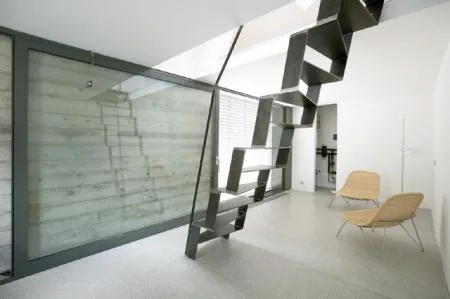
A young generation of architects trained against the background of the recently changed political and social circumstances in the country has already emerged in Slovenia. The scope of their activity is both far more international and far more ambitious. Despite having studied abroad most of these young architects have returned to Slovenia. This “six-pack” generation (the name is derived from the title of an exhibition presenting six young studios) took the somewhat complacent architectural scene by surprise and won several important competitions. Relatively young architects were assigned important tasks, which aroused great interest among their peers abroad. Slovenia began to be considered (somewhat exaggeratedly) the country of great opportunity for young architects. The majority of the group that included Jurij Sadar (1963-), Tadej Glažar (1964-), Vasa Perović (1965-), Boštjan Vuga (1966-), Matija Bevk (1972-), Aljoša Dekleva (1972-) and Tina Gregorič (1974-) continued their studies at the AA in London, or at the Berlage Institute in Amsterdam. From there they imported some fresh architectural ideas, but also a goodly portion of self-confidence. They have received a number of awards abroad, followed by considerable media coverage. An even younger generation is now emerging hot on their heels. Apart the housing in Portorož by AA Kultura the projects that have been implemented to date by this youthful group are so far limited to interiors (AKSL) and small urban interventions (Prostorož). But in comparison to the previous generation, a deep sense of cultural responsibility can be sensed in their work. They consider what they do not as architecture alone but as activity within a broader cultural context. This responsibility of an architect towards the social context is a virtue we missed for many decades.
(*) The expression “Socialist Realism” means a socialist art style approved in 1932 by the Central Committee of the CPSU as a directive for literature, fine arts and music and that later became compulsory for the whole socialist system. Socialist realism as the official doctrine dominated Soviet art until the Soviet Union collapsed in the late nineteen-eighties of the 20th century. It had its strongest impact in the aftermath of WWII. Requirements became less strict after Stalin’s death in 1953.BIOGRAPHY > Andrej Hrausky
Hrausky studied at the faculty of architecture in Ljubljana. Since completing his studies in 1976 he has worked as an architecture critic, exhibition curator, publicist and as a lecturer focusing on "Slovenian architecture". Andrej Hrausky has been a member of the AB magazine publishing team since 1975, director of the DESSA architecture gallery in Ljubljana since 1982, and manager of the same since 1989. He has headed the Arhé architectural firm since 1990. He organised more than 150 exhibitions in Ljubljana and abroad and held lectures and talks around the world about Slovenian architecture. Hrausky published in renowned, international architecture magazines including Arch (Bratislava), architektur.aktuell (Vienna) or Domus (Milan), and wrote several books, e. g. on the Slovenian architect Jože Plečnik or an architecture guide to Ljubljana published in 2002. Andrej Hrausky also acts as a judge for international architecture awards and competitions; most recently, he was Slovenian commissioner at the 2004 Venice architecture biennial. Translation:
[Y'plus] Graz - http://www.yplus.at/
- Verfasser/in:
- Andrej Hrausky, introduction to SLO} {interviews