Sadar Vuga are the stars of the young Slovenian architectural scene. Founded in 1996 by Jurij Sadar and Boštjan Vuga in Ljubljana, the practice became internationally renowned with its first project, the Slovenian Chamber of Commerce and Industry in Ljubljana, a project that resulted from an open competition they won. Their conceptual approaches influenced an entire generation of young Slovenian architects, and a considerable number of today’s young Slovenian agencies were founded by former collaborators of the duo.
GAT: Sadar Vuga could in many ways be seen as the point of origin of the young Slovene architecture scene. What do you think about this development? How do you feel as the godfathers of the most recent architectural generation?
Vuga: It is true that we are the oldest among the younger generation. When we founded our group in the middle of the nineties, we were the first practice with a modern advanced structure. Before, in the eighties, there were the major practices which were close to the government and had a hundred or even more collaborators, but nearly all of them failed at the end of the socialist system. And then, in the early nineties, there was this trend towards free-lance architects who formed so-called umbrella companies. These federations ensured their members authorization, insurance coverage and other things.
GAT: Did you also start your activities in this way?
Vuga: No, we are the very opposite of an umbrella company. We started to work as a small but professional practice, with its own authorization and insurance.
Sadar: In a way, our practice is emblematic of Slovenia’s time of transition in the nineties with its impact not only on architectural practices, but also on social, political and institutional conditions. Young architects with little experience had good opportunities at that time to get major orders – if they were good or lucky enough to win a competition. As a young practice you usually start with smaller projects, interior design and similar things, but what happened to us was exactly the opposite. This enabled us to structure our practice as a professional office according to international standards. What I mean by this is above all our mode of working: communication and teamwork are essential for us. Architecture is not an individual performance, but the result of an intensive co-operation of internal and external team partners. So we were actually the fist ones who tapped the full potential of that transition period in Slovenia. Today there is a series of practices acting professionally in a similar way.
Vuga: Three or four of today’s young offices were founded by people who had been working with us before. So yes, we are actually somehow the ancestors of this young generation. However, what we criticise is that the young teams have pretty well accepted the current situation and condition as it is. They are actually satisfied with getting orders and working out projects. They are not ambitious enough to add extras to their designs.
GAT: But even Sadar Vuga were criticized lately for being commercial, accepting every order and fulfilling client wishes without questioning.
Vuga: It is one thing to accept orders and another to give quality to a project; a shift, something provocative that would cause reflection. We are not a commercial practice at all, because we invest all our profit into research and development of our work. If time is money and if opportunities are sparse, this is the best way to remain innovative.
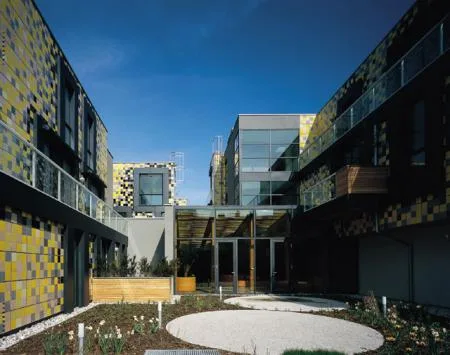
Sadar: What we are worried about is that the young generation tends to simply import international architectural trends to Slovenia, where in fact it would be important to act within and from the local context. A project is determined by site-specific conditions, by the clients’ requirements and by financial guidelines. This can be seen, for example, in our housing developments, where we try to define a new type of urban lifestyle.
GAT: But your “Condominium” housing development – a closed apartment block for upper-class people in the center of Ljubljana – could also be seen as an imitation of the American model of a gated community.
Sadar: It is true that this housing development is gated. But it is also extroverted thanks to the way the rooms are arranged, thanks to the extensive use of large balconies. So I would not say the building is inward-looking. And due to the fact that the Condominium is surrounded by one-family houses which are gated as well, it certainly represents an implementation of a new type of social living in the very residential area in close proximity to the city center.
Vuga: What is important for us is to ask ourselves how people live and work and how they would like to live and work in future. Buildings are generators of social reality. How can standard programs be re-thought? What is the relationship between a building and its environment? As architects we sell ideas. Implementing them is not necessarily our task. Our approach is to conceptualize the city, its development, its dynamics versus a static or frozen position. Our approach is to conceptualize a tendency of continuous change of the city image. Regarding Ljubljana, adding a new Layer of the city identity is simply phrased as “Formula New Ljubljana”.
GAT: What is the Formula New Ljubljana about?
Vuga: We are convinced that the identity of a city is in permanent change. So we develop quarters whose potentials have not yet been defined, be it the former tobacco factory next to the city center, where high-rises could be implanted, or the BTC shopping center on Ljubljana’s periphery, which aims to become the biggest shopping center in Europe. Concerning the BTC, we submitted a program for re-planning the site on our own initiative and recently managed to bring together representatives of the city government and delegates of the BTC owners for the first time.
GAT: Co-operation between town planners and politicians seems to be quite hard, despite the efforts of ambitious investors.
Sadar: Basically there is a lack of visions. 1996, when we founded our practice, was the peak of the transition period in Slovenia, energetically speaking. Our first project, the Slovenian Chamber of Commerce and Industry in Ljubljana, somehow reflects the social and political conditions of that time. Unlike today, society was ready then to admit fresh radical projects. Today, the state system has established itself, but the government has no idea of how to represent the new conditions of our country in architecture.
Vuga: Today’s opportunities , due to the new political situation, due to Slovenia’s geographical situation at the gateway between east and west, and last but not least due to its integration into the European Union are hardly being used. This is not only true of politics, which seems to be withdrawn in its internal policy, but also of architecture. Without opening up possibilities for foreign architects to be commissioned in Slovenia, we can hardly expect to see Slovenian architects working abroad. Very logical, indeed …
Translation: [Y'plus] Graz - http://www.yplus.at
- Verfasser/in:
- Fabian Wallmüller, talk