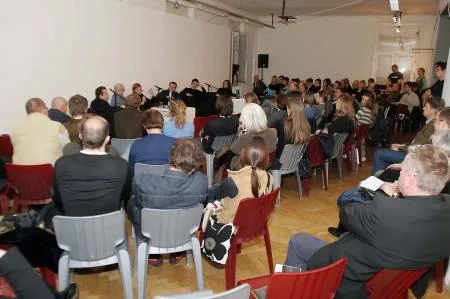
Commentary on the event SLO} {discussions 1 “Young Slovenian Architecture: A cultural import or critical regionalism?“ on March 29th, 2006 at HDA Graz; written by Karin Tschavgova
Young Slovenian architecture and urban development in focus – part 1. At the beginning the question was about Slovenian identity, at the end it was about whether we should strive for critical regionalism at all.
The title already indicated the direction. On the first evening of the ZV series SLO} {discussions “Young Slovenian Architecture: A cultural import or critical regionalism?“ on March 29th at Haus der Architektur, it was about fathoming out whether recent Slovenian architecture was developing its own unmistakeable profile, a Slovenian identity. In order to do so, the organisers invited Andrej Hrausky, the most profound expert and consistent observer of Slovenian architectural creation, probably on the hunch that the producers of architecture invited, the duo Dekleva Gregoric (Ljubljana), working in Slovenia since 2003 and AKSL Arhitekti group (since 2000 also in Ljubljana), would refrain from analysing their own work.
In his comprehensive introduction, which was accompanied by pictures, and going back quite far, Andrej Hrausky pointed out Joze Plecnik’s work and thus the most successful moment in the history of Slovenian architecture. He thereby made it clear why we are discussing the question of identity and critical regionalism in the first place. Joze Plecnik (1872-1957) has given an example. In his highly recognised buildings, even today we can see European influences ranging from Otto Wagner to Modernism, albeit transferred into an architectural language of his own, showing a clear devotion to local tradition and craftsmanship in addition to his love for classical monumentality. Modern regionalism was continued after the war by Edvard Ravnikar, the central figure of the Faculty of Architecture in Ljubljana. Edvard Ravnikar tried to combine his experiences gained from his work at Le Corbusier’s studio with the tradition of the Plecnik school, wanting to develop a regional variant of the International Style.
The work of AKSL Arhitekti seems to be free of (intimidating) influence by the great “ueber-fathers” Plecnik und Ravnikar. Ales Kosak and Spela Leskovic belong to the youngest generation of architects, but unlike their colleagues Dekleva Gregoric, they stayed in Slovenia after having finished university. In the presentation of their works, they pointed out that their approach to a concrete task is not a programmatic but a pragmatic one. The works shown – interiors of a coffee shop in Kranj, a restaurant, a hairdressers shop and an advertising agency in Ljubljana, conversions, extensions and competition contributions to single detached family houses and three medium public ones are exact, detailed and sophisticated services, orientated to the needs and means of the clients, in their form and appearance generated from the corresponding building task.
With their perfect use of the English language, Decleva Gregoric already illustrate that, through their postgraduate studies at London AA, they have become citizens of the world. Their motto, “Design as research and response” as well as the focus on the user, and the material used, are not so much an expression of Slovenian identity as of an event-based “pragmatic” approach to task and design. The two architects, aged just over thirty, presented the housing development “3 for one” in Sezana (on the Italian border) and their winning project for a housing competition dominated by aspects of urban development from 2006. They managed to develop their own profile with the miniature project XXS-House in Ljubljana, in which they succeeded in developing astonishing spatial, formal and lighting qualities on the basis of the rigorously restrictive conditions.
This small object-like début feature gave Decleva Gregoric the international attention, which always also leads to the question about the typical Slovenian characteristics in the architecture of the young Slovenian generation. The projects presented by both groups on the evening at HdA did not show any national specifities. Despite Andrej Hrausky’s endeavours to formulate Slovenian characteristics, we must note, that respect for the “genius loci” and the ability for precision detailing do not constitute an independent and individual Slovenian way. The question suggested itself: Is it really necessary that the small country of Slovenia with two million inhabitants makes another attempt to develop architecture with a Slovenian identity? Is it not sufficient that Slovenia - also in times of a new capitalism overrunning Slovenia too - continues to hold on to value and importance of top-quality construction for society. We had the impression that this was what Decleva Gregoric and AKSL Arhitekti had resolved for their work - no more and no less.
Photos: MARIO GIMPLAnother terms:
Wednesday, April 26, 2006, 7.00 p.m. - HDA Graz, Engelgasse 3-5
SLO} {discussions 2
Topic: Medium Size City: Opportunities for urban development in Ljubljana
Theorist: Roemer van Toorn [NL]
Architects [SLO]: Bevk in Perovic Arhitekti, Monochrome Architects
Discussion leader: Martin Krammer
Wednesday, May 31, 2006, 7.00 p.m.
Topic: Slovenia and Austria: Everybody for himself or together we are stronger?“
Theorist: Andreas Ruby [D]
Architects: Sadar Vuga Arhitekti [SLO], Roger Riewe [A]
Discussion leader: Martin Krammer
> > SLO} {exhibition
“NEXT TO YOU: Young Architecture from Maribor”
In Cooperation with Umetnostna Galerija Maribor / Maribor Art Gallery
at HDA Haus der Architektur, Engelgasse 3-5.
Duration of exhibition: March 30 – May 31, 2006
Opened from monday to friday 10.00 a.m. - 6.00 p.m.
- Verfasser/in:
- Karin Tschavgova, commentary