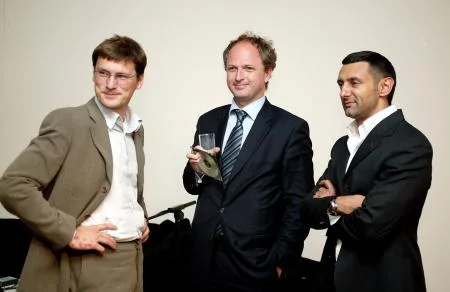
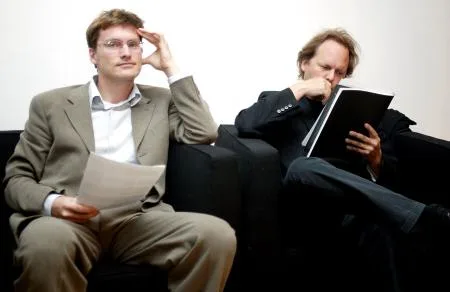
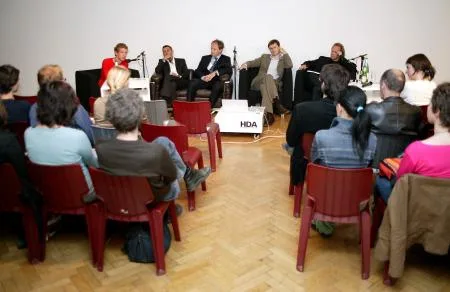
The third and last evening of the series of lectures “SLO}{discussions” at the House of Architecture on the 31st May, 2006, was dedicated to the topic “Slovenia and Austria: Every Man for Himself or Together We are Strong”. The lecturers tried to solve the question of how the identity of sites can be opened or enlarged. Mental and political borders should be overcome in order to make way for internationality. In this context economy can serve as an example for art and more particularly for architecture. The lecturers analysed the relationship between Graz and Maribor and the urban planning situation in Ljubljana. The organisers had invited Andreas Ruby (architecture critic and theorist), Boštjan Vuga (Sadar Vuga Arhitekti, Ljubljana), Miha Zupanc (Operative Director, BTC Ljubljana) and Roger Riewe (Riegler Riewe architects, Graz). Fabian Wallmüller and Andreas Ruby were the hosts.
Andreas Ruby’s lecture dealt with locations: Slovenia and Austria are neighbors. However, due to historical circumstances both countries have had distinct individual cultural developments. Cooperation between these regions would require a specific concept of identity, so that an individual on a specific site could give up a part of his own identity in favour of other locations and nourish himself from a second identity. Ruby criticised the fact that people maintained that sites which were “produced” at a certain time had turned into sites that were only curated today. Today, he said, artificial places were “made” (so-called non-places) and transplanted into other sites (indoor ski slopes, ocean domes, etc.). In order to make the transplantation of site qualities (from one site to another) perceivable, Ruby offered his listeners a sample of a piece of music by a British-Indian DJ who in his compositions mixes Indian music with drum & base sequences in a highly artistic manner.
The Slovenian investor Miha Zupanc talked about BTC Ljubljana, the largest shopping center in Europe.
BTC developed from the inland warehouses established in 1975 in the fields near Ljubljana, with an area of 45 hectares. More than 4000 people are working in 420 shops visited by 18 million clients per year. There are also office buildings, sports facilities and areas for cultural activities intended to attract an international audience. The complex was built by 40 individual architects. As an example of international design Zupanc referred to a water park made by a German architect.
Zupanc and his company would like to make BTC the greatest shopping center in the world – they have even planned a two-day “Shopping Festival” – consumption without borders.
Boštjan Vuga’s lecture developed Ruby’s idea of “artificial places” further. BTC is such an artificial place, the Ljubljanaers showed no interest in BTC at first, although it was a new adjacent city quarter, and were unwilling to integrate BTC City. Ljubljana as a city is very proud of its architectural development with Plečnik and Ravnikar and has not changed much during the last fifteen years or so. A bronze model of the city of Ljubljana in the city center symbolises its frozen state.
Ljubljana city versus BTC City? In a study made by Sadar Vuga Arhitekti last year in Barcelona’s IAAC institute in order to outline visions for a new integrative approach for the city, the team posed the following questions: What can we add to a city which seems already perfect, so that it becomes really perfect? How could a link between the city of Ljubljana and BTC City work, how could synergies be used?
A new urban stratum was created, called “the formula of New Ljubljana”. It is intended to trigger dynamic transformations in Slovenia, because urban images must change on a continuous basis. A new enriching identity for Ljubljana could grow on the new layer,. Then its inhabitants could still decide whether they would rather belong to the new layer or to the frozen city.
Roger Riewe’s guiding idea was that borders were only abstract constructs. Already ten years ago the architects of Graz discussed what would happen if Slovenia joined the EU. In 1999 the Zentralvereinigung project “Graz-Maribor: Spaces of future” was created. The so-called California Line was planned, a continuous transport link from Portugal via Trieste, Ljubljana, Budapest to Kiev, with a branch to Thessaloniki (an EU-project). It became necessary for Graz to orientate itself towards the south, so that it could dock onto that new intersection. An Internet platform was created (by Zentralvereinigung) to evaluate the potentials of the Graz-Maribor region, which failed, but there were talks and a debate on the lower political levels, and some echo in the press.
In the discussion it became clear that Ljubljana is in a contradictory state insofar as it would like to grow on the one hand, and is afraid of losing its identity through internationality on the other. The economist lobby strives for expansion whereas the architects want to boost themselves by means of cultural production. This contradiction could be exploited, but it is not clear how an extroverted identity policy could work. Are architects heard and can they help to enhance a trans-local identity? The polyglot Slovenes are ready for a wider spanning concept of identity. They know that they must move on and outward. Slovenia is in a kind of abeyance since it joined the EU. The Trieste-Ljubljana-Graz-Maribor region will reorganise itself and the current political borders will become meaningless. Foreign use is of growing importance for the development of new identities; dominant local identifications should be refracted by nomadism.
Translation: [Y'plus] Graz - http://www.yplus.at
- Verfasser/in:
- Vilja Popovic