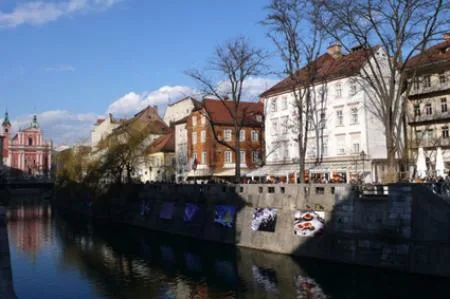
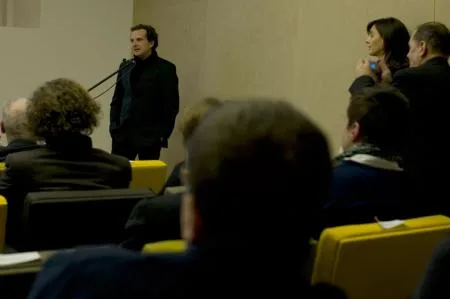
Ljubljana was the third and concluding venue in the conference series SLO ITA AUT, in which architects from Slovenia, Italy and Austria came together once again to exchange their thoughts. This time “hostess” Spela Hudnik von monochrome architects (Ljubljana) took the audience through the perfectly organised event at the picturesque municipal museum.
Martin Spindelegger, Austrian Federal Minister for European and International Affairs, made the opening address ahead of the list of key speakers and as an outsider He quoted Coop Himmelb(l)au with the phrase “architecture must burn” referring to the long standing tradition of Austrian architects à la Heinrich von Ferstel, and the remarkable array of representative buildings they left in the Upper Adriatic region that now lies outside the borders of modern Austria.
Mayor of Ljubljana Zoran Jankovic talked about the necessity to continuously develop new visions to make sure that a city continues to stay vital and alive. In this spirit a new master plan for Ljubljana is currently being elaborated and the harmonising of old and new structures will be its central theme. The participation of architects from abroad is being encouraged in the open competitions, which are soon to go to tender.
In his opening speech, Peter Piffl-Percevic, city councillor in Graz, emphasised the intertwinement between national identity and the international standard for architecture. Roberta Ferazza, head of the Italian Cultural Institute followed a similar path by saying: “We cannot build a future without knowing our tradition.”
Unfortunately Martin Krammer’s words were slightly drowned in the shuffle caused by politicians leaving, who except for Piffl-Percevic followed the call of their busy agendas. But the head of ZV Styria saw the lighter side of this saying the event might in any case benefit from having more visitors than politicians.
Presenter of the evening Trieste-based architect Giovanni Damiani then opened the floor with “Let’s dance!” the motto of this third event.
Amongst others, Alfred Bramberger (BRAMBERGER | [ architects ], Graz) presented two projects, which were realised in cooperation with Atelier Thomas Pucher. Tartu Rebase Street in Estonia immediately introduced a topical situation that is currently shared by many other architects. The housing project at the Emajoe River, which was originally planned to consist of nine objects was put on ice after completion of a single building due to the current financial crisis. The current “lighthouse project” by Bramberger Pucher cooperation, which is the headquarters for the Organisation of the Islamic Conference in Jeddah, Saudi Arabia is in a better situation. The plan still awaits some fine-tuning, but building works are expected to begin this year.
Whilst Alfred Bramberger ironically perceived himself as a baroque Gavotte dancer alluding to his refurbishment of the Graz Alte Universität, which was built in+ the 17th century, Marion Wicher (YES architecture, Graz) felt more attracted by Rap. In a “fast forward” – overview of works she pointed out what dance repertoire must be offered by a modern architect, ranging from a bathroom unit at a detached single-family house to the YES flagship which is just about to be completed, the International Conference centre in Bonn.
Martin Lesjak from Innocad Lila (Graz/Vienna) presented House Music videos on the Ljubljana architecture dance floor. The three buildings from Graz that were presented, Golden Nugget, home base and the most recent finalised Schwarze Rose am Lend were intended to stimulate the development of architecture in urban fringe area by means of a powerful input with distinct façade colours and design.
Matteo Ghidoni (Salottobuono, Venice) probably presented the most political project of the evening, hence the Rock and Roll. Being one of the partners in the “Decolonizing Architecture” project by Hilal-Petti-Weizman, Salottobuono made a manual on the repatriation of buildings built during the Israeli occupation for the Palestinian people on the West Bank territory. Together with the people involved on site, the manual was designed as a kind of eight-step jigsaw, in order to give various different scenarios a basis for implementation.
Metrogramma took a jive on the dance floor. Andrea Boschetti requested a new vision for his hometown with “Milan 5 Cities“, Milan hosting the Expo in 2015. He propagated ‘ less is more’, since higher construction density usually does better service for the investor more than the inhabitant. His Milan of the future, favours public space, accessible for everybody. Finally MAP from Venice presented the Last Waltz in a pas de deux. The studio managed by Francesco Magnani and Traudy Pelzel focuses on the juxtaposition of old and new. Due to the fact that authorities have set the bar relatively high in regard to the requirements for the restoration or refurbishment of old buildings, great sensitivity is needed as they showed in the refurbishment of Torre di Porto Nova in Venice.
Architecture in times of crisis. Are we now all dancing on the volcano, could we elegantly tango out of the crisis, or will we need to invent totally new steps? Finally Giovanni Damiani took the panel through the discussion in a Quickstep since due to the speaker’s enthusiasm the available time had been used up.
Alfred Bramberger stated that not all dances live purely from movement but they also require mind control. By means of controlled steps we can make sure to maintain our autonomy. Innocad say they also notice how the budgets have shrunk, however, smaller projects too have every right to be jolly. Martin Krammer perceives the increase of Nomad behaviour and a changeover from traditional cities to Science Cities as a thrilling challenge for the future. Marion Wicher added that independent from the size of the budget, the most important thing is to maintain respect for cultures and people also in times of crisis. Analogue to his Milan concept, Andrea Boschetti demanded new thinking. Public space is what makes each city special. Private money, of which there is still enough, should increasingly be invested in public space: “the future is today.”
Matteo Ghidoni too, thought the time has come to overhaul the old pattern of taking one step with the public and one with the investor.
Francesco Magnani returned to a retrograde approach: “We should first discover the exiting wealth we have in hand before dedicating ourselves to visions.”
CONTACT:
ZV Steiermark
Zentralvereinigung der Architekten Steiermark
c/o HDA Haus der Architektur im Palais Thinnfeld
Mariahilferstraße 2, 8020 Graz
Project management SLO ITA AUT: Martin Krammer, Anke Strittmatter
Contact & organisation:
Arch. DI Anke Strittmatter
strittmatter@osa-online.net
Organisation conference in Ljubljana:
Spela Hudnik, Monochrome Arhitekti
Anke Strittmatter
SLO ITA AUT, a follow-up event of Architekturschwerpunkt (architectural focus) 2006: Slovenia (SLO), is a conference series between three countries that promotes the exchange of expertise and forging of links between architects and people interested in architecture, reaching across borders. Just like in 2006, ZV Steiermark (Styrian central organisation of architects) acts as initiator and co-ordinator, having developed the concept in close collaboration with partners in both Slovenia and Friuli.
- Verfasser/in:
- Emil Gruber, report
Weiterführende Links