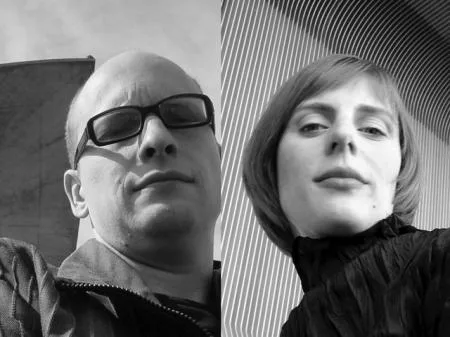
As many of their Slovene colleagues, Aljoša Dekleva and Tina Gregorič did postgraduate studies abroad. Since being back in Slovenia, they have adopted a deliberate international attitude. In 2003, they opened the agency Dekleva Gregorič Arhitekti in Ljubljana; in 2004, they attracted a great deal of attention together with five other young offices when their works were shown in the framework of “Sixpack”, a worldwide exhibition on young Slovenian architecture. In Slovenia, these offices earned as much acceptance as denial. The allegation was that they imported culture without questioning it, or gave up their national identity. Did these young architects break with their own past? GAT interviewed Aljoša Dekleva and Tina Gregorič.
GAT: The Architectural Association in London and the Berlage Institute in Rotterdam play a central role in training the young Slovene generation of architects. You did postgraduate studies at the AA, too. Why? Were you unsatisfied with the educational situation in Slovenia?
Dekleva: No, not at all. Unlike many other universities, the Ljubljana School of Architecture has always succeeded in getting across to their students to think and express themselves in their very own way.
Gregorič: At the beginning of our postgraduate studies we had the idea to go abroad for the sake of making new experiences. Simply to see how it was there. And we liked London. Once we were there, though, we spent almost the whole time at school.
Dekleva: What makes the AA so interesting is the continuous questioning of your work by external critics. You present your proposals continuously, you have to defend them and sharpen your arguments. Whereas in Ljubljana we learnt to think on our own, at the AA we learnt to defend our work.
Gregorič: Did you actually see our book?
GAT: Have you written a book?
Gregorič: “Negotiate My Boundary!” – our diploma thesis. It was published in the form of a book.
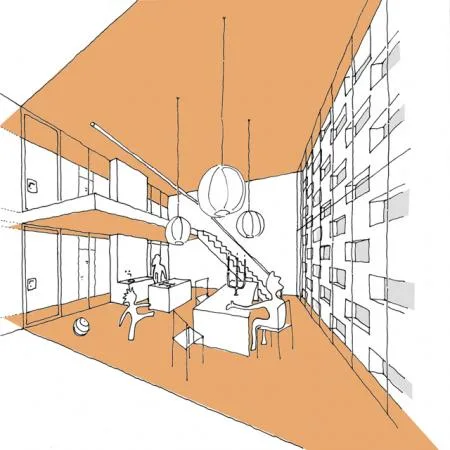
Dekleva: The work actually re-interprets the idea of participation of the sixties. But what does that mean today? Negotiate My Boundary! uses modern techniques and shifts participation in planning processes to the Internet. It is there that as a future user you cannot only intervene interactively in the typology of a house – and for instance co-design the relationship with the exterior, or the visual axes – but also create sort of a club, in which you can negotiate how common spaces shall be used. So, you start forming a community long before the building is actually finalized.
Gregorič: The book was sold out six months after its publication and earned us several international prizes. I think that it reflects an issue of interest for many people, particularly regarding social and interactive aspects. How can I adapt a building to my needs, and where are the limits of such an adaptation?
GAT: Are there any approaches for realizing these ideas?
Dekleva: There are a lot of approaches. We are for instance working on a housing scheme for the Housing Found of the Republic of Slovenia with collective spaces to be used jointly by neighbours. Methods of mass-customization can also be observed outside of architecture. Since computers have been sold online, you can choose your components freely – motherboards, graphics cards, etc. Nike is designing a shoe that you can compose yourself out of various other models. The step from there to architecture is a small one.
Gregorič: Architecture is more than form. We are interested in interaction with the users, in influencing social processes. This is the starting point of all our projects.
GAT: Young Slovene architects were more than once criticised lately for being less interested in social problems than in the media impact of their architecture. Slovene architecture critic Miha Dešman even said that global trends were transferred to Slovenia via the copy and paste principle. Your position seems to be different.
Gregorič: These reflections are not entirely unjustified. Still, according to our activities it becomes obvious that the social aspect is one of the main forces driving our projects. We understand our work not as an import of foreign ideas. When we left for the AA, we basically already knew what we wanted. We just pursued our way of thinking – and therefore we were even accused at the AA to have a too European approach and not a global one
Dekleva: Jože Plečnik studied in Vienna with Otto Wagner and later built architecture in Slovenia that everybody appreciates. Edvard Ravnikar, Plečnik’s student, worked with Le Corbusier – nevertheless Ravnikar’s architecture is deeply rooted in Slovene architecture.
Gregorič: A long stay abroad allows you to sharpen your view for what is happening at home. Things become clearer from distance. Therefore we appreciate our roots much more than if we had remained here.
GAT: So the famous break with the past actually never happened?
Gregorič: I cannot recognize such a break. In the works of some young Slovene architects I can rather detect a re-interpretation of approaches of Slovene architecture of the sixties – particularly of Ravnikar’s. Things like the shaping of details, the specific use of materials, dealing with the context in many modes or questions of social responsibility have become important again.
GAT: However, there is the reproach according to which young Slovene architects do not have enough critical distance towards the current situation in Slovenia.
Dekleva: We do not agree with that either. Precisely in order to include professional and laic public in a wider debate and critique on the current culture of architecture in Slovenia we have initiated with some other young Slovene architects the architectural web portal Trajekt [www.trajekt.org].
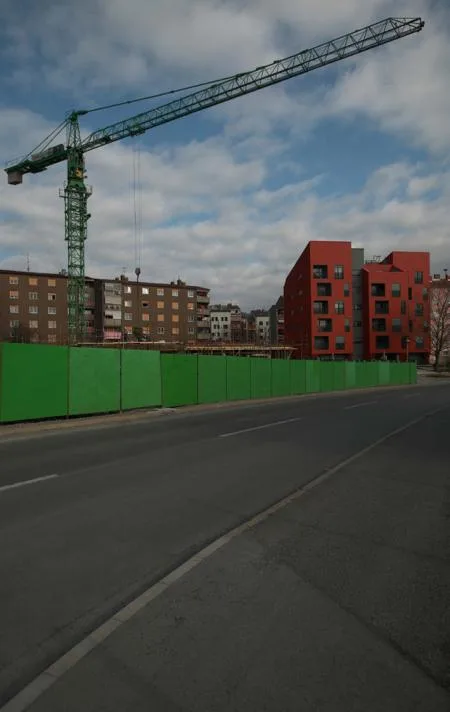
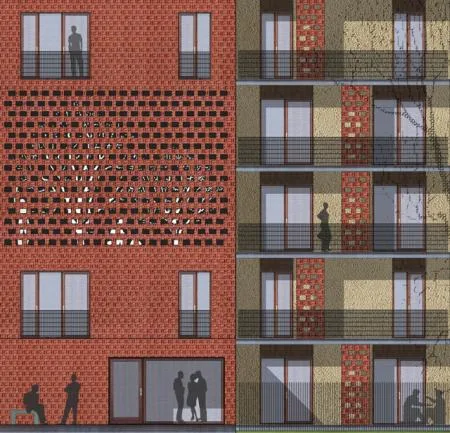
Gregorič: On the other hand, we are here to solve problems. Take our housing development in Sežana. This is a commercial project with a super low budget, but we managed to convince the investor to build quality flats and to take social aspects into account.
GAT: Does this proposal include negotiable spaces, too?
Gregorič: What we tried in Sežana was above all to offer users a high level of flexibility in the flats.
Dekleva: Generally it can be said that since the eighties, the Slovene state has withdrawn from its social responsibility in housing. Private developers emerged in Slovenia, which is understandable, since the political and economic situation has changed. You cannot criticise these changes, but several improvements should be made. Because unlike as is the case with private investment projects, housing projects subsidized by the state allow you to include a bit more culture.
Gregorič: The Slovene state is unfortunately not yet aware of the fact that architecture can play an important role for society. The State is not interested in architecture any more, as was the case in the sixties. At that time, the State represented itself by means of architecture, and equally important – that architecture was extremely experimental.
Dekleva: Every state needs architecture. All governments have always represented themselves through architecture – regardless of their political stand.
GAT: Could contemporary architecture not be interesting for the State in the sense of marketing?
Gregorič: Ljubljana’s most important trademark is still Plečnik. Currently, his architecture is much more important than any contemporary architecture – from the point of view of tourism. This is okay for us. However, a Guggenheim Museum in Bilbao or the Kunsthaus in Graz are something different, but not a relevant model for Ljubljana. Perhaps an approach like in Copenhagen seems much more appropriate.
Dekleva: Of course, behind all such projects there is always a political will behind.
Gregorič: And there is no such will in Slovenia, which is dominated by private investors. Still, I would wish for the State to take better care of publicly financed projects – improve the organization of competitions, select better projects, improve quality in building. Slovenia is a small country, we only have one Ljubljana. Every building counts.
- Verfasser/in:
- Fabian Wallmüller, talk